


TSN (Time-Sensitive Networking) Switch Technology
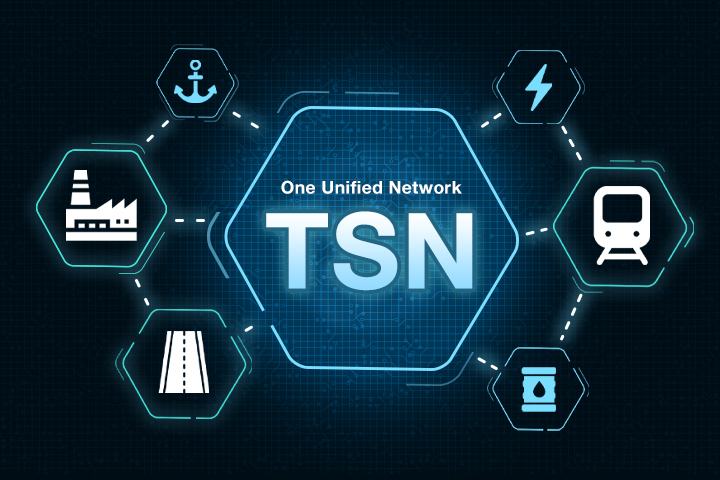
Time-Sensitive Networking (TSN) is a family of IEEE standards designed to provide deterministic communication, precise timing, ultra-low latency, and low jitter over Ethernet-based networks. TSN enables different traffic types—such as real-time control, audio/video, and best-effort data—to be transmitted deterministically over a single converged Ethernet infrastructure.
By extending standard Ethernet capabilities, TSN simplifies network architectures, reduces infrastructure costs, and significantly improves performance. TSN is based on the IEEE 802.1 standards family and is widely adopted in industrial automation, automotive systems, energy infrastructure, and telecommunications.
What Is TSN?
TSN transforms traditional best-effort Ethernet into a time-aware and deterministic network. It ensures that critical traffic is delivered within guaranteed time windows and with bounded latency, making Ethernet suitable for real-time and mission-critical applications.
With TSN, applications that previously required proprietary fieldbus or real-time Ethernet solutions can now operate on a standardized, interoperable Ethernet platform.
Evolution of TSN and Core Concepts
Background and Purpose
TSN was developed to overcome Ethernet’s inherent limitations related to latency, jitter, and timing unpredictability. Built on IEEE 802.1 standards, TSN has evolved into a foundational technology for modern industrial and critical infrastructure networks.
Time Synchronization
All network devices are synchronized to a common clock with microsecond-level accuracy using IEEE 802.1AS, a profile of Precision Time Protocol (PTP).
Time Windows (Time Slots)
Critical data streams are transmitted within predefined time windows. This prevents collisions and guarantees deterministic delivery.
Time-Aware Traffic Scheduling
With IEEE 802.1Qbv, traffic transmission is controlled according to a global schedule, ensuring that high-priority traffic is forwarded at precise times.
Deterministic Delivery and Reliability
Through redundancy mechanisms and controlled scheduling, TSN delivers predictable latency and high availability even under heavy network load.
TSN Protocol Family (Selected IEEE 802.1 Standards)
-
IEEE 802.1AS – Time synchronization (PTP profile, microsecond accuracy)
-
IEEE 802.1Qbv – Time-Aware Shaper for scheduled traffic transmission
-
IEEE 802.1Qbu / IEEE 802.3br – Frame preemption for low-latency forwarding
-
IEEE 802.1Qci – Per-stream filtering and policing
-
IEEE 802.1CB – Frame replication and elimination for redundancy
-
IEEE 802.1Qat / IEEE 802.1Qav – Bandwidth reservation and traffic shaping
TSN is compatible with VLAN (802.1Q), industrial protocols such as PROFINET, EtherCAT, and Modbus, and can coexist with IP/MPLS-based hybrid network architectures.
Time-Sensitive Capabilities
Synchronization Architecture
TSN networks use Master/Slave, Boundary Clock, and Transparent Clock architectures. The Best Master Clock (BMC) algorithm selects the most accurate clock source, and performance is verified through precise latency measurements.
Time-Sensitive Traffic Control
Traffic is transmitted only within predefined time windows using 802.1Qbv. 802.1Qci blocks malformed or unauthorized streams, ensuring predictable latency and protecting critical traffic classes.
Traffic Management and Planning
-
802.1Qci (Policing): Ensures traffic conforms to defined rules and limits abnormal streams
-
802.1Qbv (Time Windows): Enables collision-free transmission for critical flows
-
Traffic Isolation and Prioritization: VLAN segmentation and QoS-based class allocation
-
Latency and Jitter Control: Time-aware scheduling, queue management, bandwidth reservation, and shaping
Network Architecture and Topologies
TSN Switch Operation
TSN switches perform port-based prioritization, time-window-aware forwarding, and use dedicated clocking hardware to maintain precise synchronization across the network.
Supported Topologies
Star, ring, and mesh topologies are supported. Redundant paths provide high fault tolerance and operational resilience.
Redundancy and Failover
Using IEEE 802.1CB, frames can be replicated and duplicate frames eliminated at the receiver. This enables fast self-healing behavior and deterministic failure recovery.
TSN Device Hardware Architecture
-
Processor and Memory: Optimized for time-slot scheduling and deterministic forwarding
-
High-Speed Interfaces: 10G / 25G and higher, with ultra-low latency data paths
-
Traffic Shaping Engines: Hardware support for IEEE 802.1Qbv
-
Clock and Synchronization Chips: PTP-compliant, supporting Boundary and Transparent Clock functions
Market Examples
-
Simgenet TSN Series (e.g., SMG-5400TSN, SMG-6400TSN): Industrial-grade design, high port density, and precise synchronization
-
Cisco Catalyst IE3400 TSN
-
Siemens Scalance XC-200 TSN
-
Hirschmann OCTOPUS TSN
-
Moxa EDS-405A-TSN
Industrial Use Cases
Automotive
Microsecond-level synchronization for sensors and cameras in autonomous driving systems, with prioritized and redundant data transmission.
Manufacturing and Automation
Deterministic communication for robotic control lines, enabling synchronized and error-free production processes.
Energy and Critical Infrastructure
Priority handling of critical telemetry in smart grids, with redundant networking for uninterrupted operation.
Telecommunications and Broadcasting
Low-latency, low-jitter transmission for live broadcasting, VoIP, and video conferencing, ensuring audio-video synchronization.
TSN Comparisons
TSN vs Standard Ethernet
TSN provides deterministic delivery with bounded latency, while standard Ethernet operates on a best-effort basis.
TSN vs IP/MPLS
IP/MPLS is highly effective for WAN and backbone networks, whereas TSN delivers superior low-latency and precise timing within local and industrial networks.
Alternative Time-Sensitive Technologies
PROFINET, EtherCAT, TTEthernet, and Deterministic Ethernet are alternatives. TSN stands out due to its broad interoperability, IEEE standardization, and Ethernet convergence.
Advantages and Current Limitations
Advantages
-
Deterministic traffic delivery
-
Ultra-low latency and jitter
-
Redundant transmission paths
-
Compatibility with existing Ethernet infrastructure
Limitations
-
Higher hardware cost
-
Requirement for precise timing hardware
-
Planning complexity at LAN scale
Ongoing standardization, ecosystem maturity, IP–TSN integration, and training programs continue to address these limitations.
The Future of TSN
-
New Standards and Modular Profiles: Application-specific TSN profiles
-
IIoT Integration: Real-time analytics and closed-loop control
-
5G / 6G Integration: Ultra-low-latency deterministic networking with network slicing
-
Artificial Intelligence: Traffic prediction, optimization, and proactive fault detection
-
Quantum Technologies: Quantum-safe encryption and nanosecond-level timing using quantum clocks
Final Assessment
This TSN content serves as a technical reference document, not just a blog post. It is suitable as a central knowledge hub for linking TSN switch products, industrial solutions, and advanced Ethernet architectures.