




What Is IP MPLS?
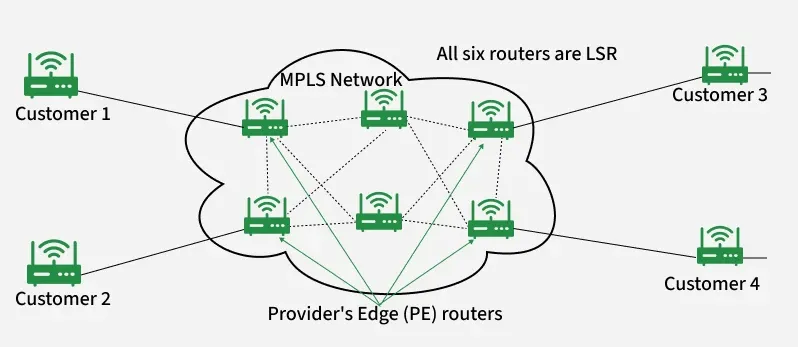
IP MPLS is a technology in which packets are transported within the network not only based on their destination IP addresses, but also through a label-based forwarding mechanism. At the ingress of the network, packets are classified, assigned appropriate labels, and then forwarded across the network backbone more efficiently and consistently using these labels.
This approach makes network behavior more deterministic and predictable, especially in large and complex backbone networks.
How Does IP MPLS Work? (Label Concept and LSP)
In MPLS networks, traffic is typically carried over paths known as Label Switched Paths (LSPs). The basic operating principle is as follows:
-
At the ingress node, packets are classified and labeled
-
Core routers forward packets based on labels without inspecting the IP header
-
At the egress node, the label is removed and the packet is delivered to the destination network
This structure ensures consistent behavior across the backbone. Policies such as “this service must follow a specific path” or “this traffic must be prioritized” can be applied in a stable and controlled manner throughout the network.
Difference Between IP MPLS and Traditional IP Routing
In traditional IP routing, each router determines the next hop by examining the destination IP address of the packet. While this approach may be sufficient for small and simple networks, it introduces several challenges in large-scale backbone environments:
-
Traffic behavior can become unpredictable during congestion
-
End-to-end QoS policies may be applied inconsistently
-
Service separation and isolation become more difficult
-
Operational complexity increases as the network grows
IP MPLS, on the other hand, provides a more structured and controllable backbone architecture. This difference directly contributes to operational stability, particularly in service provider and critical infrastructure networks.
QoS and Traffic Management: Protecting Critical Services
In critical infrastructure environments, not all traffic has the same level of importance. For example, treating SCADA control traffic with the same priority as CCTV video traffic can pose serious risks to system stability.
IP MPLS architecture enables more precise and reliable QoS enforcement:
-
Traffic classes can be defined (critical, important, best-effort)
-
Latency-sensitive services can be prioritized
-
Bandwidth management can be applied using shaping and policing
-
End-to-end service behavior becomes more consistent
This allows multiple services to coexist on a single backbone while ensuring that critical traffic remains protected even during peak load conditions.
High Availability: Fast Reroute and Resilience
One of the most important requirements in energy, railway, and telecom backbone networks is rapid recovery in the event of failures. In IP MPLS environments, this requirement is commonly addressed using Fast Reroute (FRR) mechanisms.
The objective is straightforward:
When a link or node failure occurs, traffic is redirected to an alternative path within milliseconds. This minimizes service disruption and allows critical applications to continue operating without noticeable interruption.
Why IP MPLS Is Preferred in Energy and Railway Projects
In environments such as energy transmission centers (154 kV / 400 kV), substations, and railway corridors:
-
Communication outages are unacceptable
-
SCADA, teleprotection, CCTV, and signaling systems share the same backbone
-
EMC/EMI resistance and harsh industrial conditions are critical
-
Ring and mesh topologies with redundancy are required
IP MPLS stands out in these scenarios due to the following advantages:
-
Ability to carry multiple services over a single backbone
-
High resilience in ring and mesh network designs
-
Traffic prioritization to protect mission-critical services
-
Compatibility with existing infrastructure when required
For these reasons, IP MPLS is often deployed as the core communication backbone in industrial and critical infrastructure projects.
IP MPLS in Telecom and ISP Networks
Telecom operators and Internet Service Providers operate networks with different scaling requirements, including high subscriber density, diverse service types, and continuously growing backbone capacity demands.
IP MPLS is widely adopted in these networks for several key reasons:
-
Efficient use of backbone capacity through traffic engineering
-
Customer isolation using L2VPN and L3VPN services
-
Scalable service delivery across metro and core layers
-
Unified management of voice, video, and data services using QoS
In short, IP MPLS is one of the fundamental building blocks of large-scale telecom and ISP networks.
Conclusion: IP MPLS Is an Infrastructure Approach
IP MPLS is not merely a routing technology; it is a comprehensive transport architecture designed for critical infrastructure and service provider networks. When implemented with appropriate hardware and a well-designed architecture, IP MPLS provides a robust, scalable, and long-term communication backbone capable of supporting complex and demanding operational environments.