




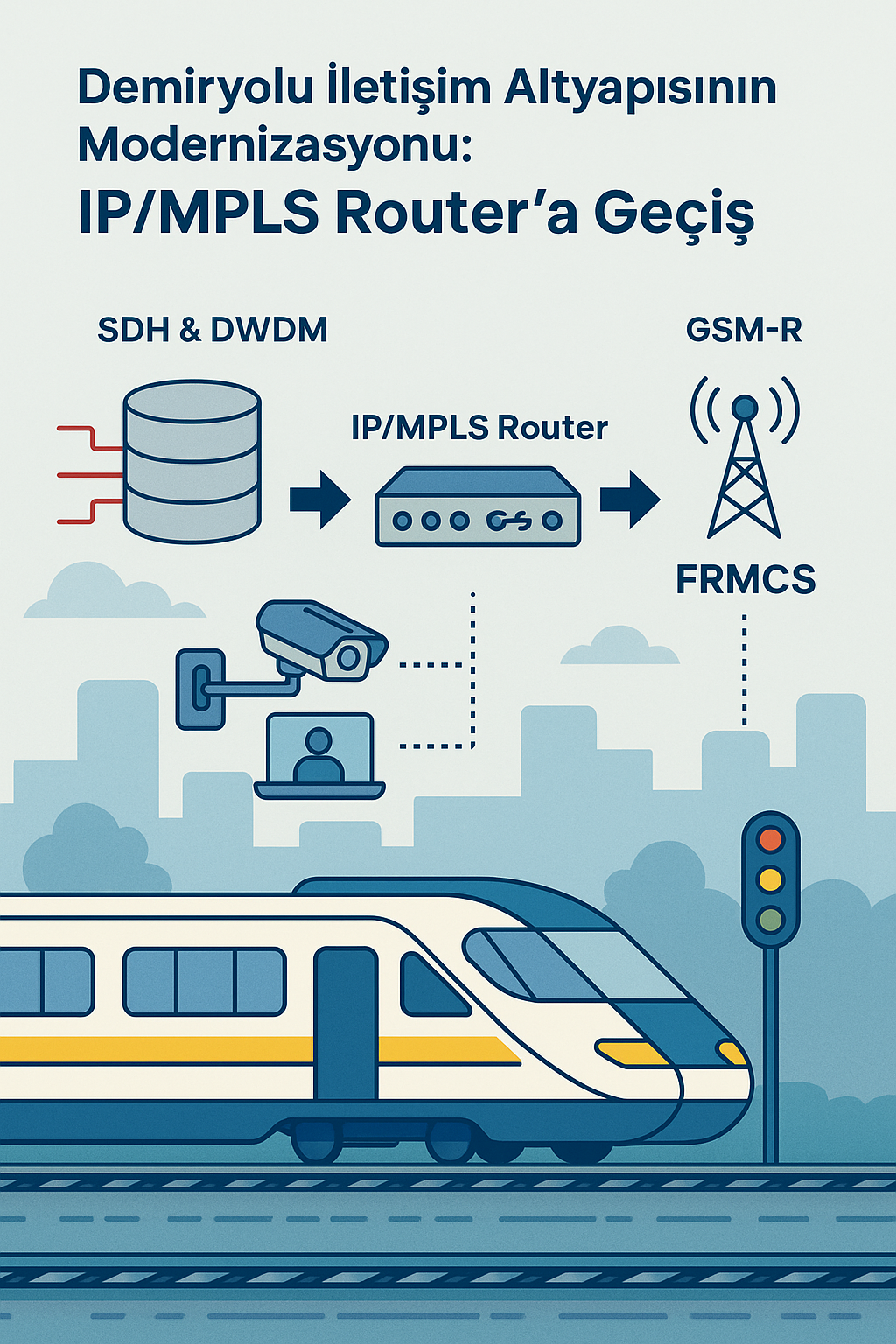
Modernization of Railway Communication Infrastructure: Transition from SDH & DWDM to IP MPLS Routers
SDH & DWDM Multiplexers vs. IP MPLS Routers
Objective
The objective of this study is to examine how the transition from traditional SDH and DWDM infrastructures to IP MPLS routers can reduce device diversity while providing flexibility, cost advantages, and scalability in railway communication systems.
Overview of SDH and DWDM Technologies
Existing Systems
SDH (Synchronous Digital Hierarchy):
-
Provides time-synchronized and reliable data transmission.
DWDM (Dense Wavelength Division Multiplexing):
-
An optical communication technology that enables very high bandwidth.
-
Commonly used in CCTV and high-capacity railway communication infrastructures.
Strengths
-
SDH provides strong synchronization and data reliability.
-
DWDM delivers extremely high bandwidth capacity.
Limitations
-
Both technologies require separate dedicated devices.
-
Network management is more complex.
-
Maintenance and operational costs are high.
Overview of IP MPLS Router Technology
A Modern Alternative: IP/MPLS (Multi-Protocol Label Switching)
-
Integrates the functions of SDH and DWDM into a single routing platform, providing flexibility, cost efficiency, and simplified management.
Advantages
-
Combines the benefits of SDH and DWDM in one device.
-
Aggregates all network traffic onto a unified platform.
-
Eliminates the need for multiple standalone systems.
-
Provides vendor independence, rapid scalability, and multi-service support (video, voice, data).
Comparison of SDH, DWDM, and IP MPLS Routers
Why Replace SDH and DWDM Devices with IP MPLS?
-
Fewer Devices, Less Complexity:
IP MPLS routers integrate SDH and DWDM functionalities into a single solution, reducing device diversity. -
High Bandwidth:
MPLS optimizes high-speed data traffic and provides scalable bandwidth. -
Technological Simplicity:
Network management complexity caused by multiple interoperating systems is eliminated. -
Cost Savings:
Removing the need for separate SDH and DWDM devices significantly reduces installation and maintenance costs.
Simplified Railway Applications with GSM-R and IP MPLS Routers
Single Platform, Multiple Services
Camera systems, signaling, passenger information systems, and GSM-R communication services can all be managed over a single IP MPLS platform.
Integration of GSM-R with IP MPLS:
-
Enables secure and uninterrupted voice communication along railway lines.
-
Allows other applications to operate over the same network.
-
Simplifies management and reduces operational costs.
Broadband Requirements
-
IP MPLS provides high performance for bandwidth-intensive applications such as high-resolution video, passenger information systems, and signaling.
-
Enhances the reliability and security of critical GSM-R communication services.
Dynamic Traffic Management
-
Provides flexible and dynamic traffic management for all railway applications and GSM-R traffic.
-
Network traffic can be prioritized based on service criticality.
-
Critical communication signals are handled with higher priority.
Conclusion
-
Beyond SDH and DWDM:
IP MPLS routers offer a versatile solution that combines the advantages of SDH and DWDM while supporting critical communication systems such as GSM-R. -
Future-Ready Infrastructure:
IP MPLS technology supports both current and future broadband requirements of railway networks and enables scalable, sustainable integration with next-generation systems such as FRMCS.
Other Important Technological Details
GSM-R Technology
GSM-R (Global System for Mobile Communications – Railway) is a 2G-based technology adapted specifically for the railway sector.
Key Characteristics:
-
Operates in the 900 MHz frequency band.
-
Optimized for signaling and voice communication.
-
Data transmission rates are limited, typically around 9.6 kbps.
Future Technologies
-
GSM-R is considered a legacy technology due to its 2G foundation.
-
The transition to FRMCS (Future Railway Mobile Communication System), based on 5G technology, is planned.
-
FRMCS aims to provide higher data rates, improved security, and broader application support.