

- Products
- Solutions
- About Us
- Blog
- Contact
-

-

-

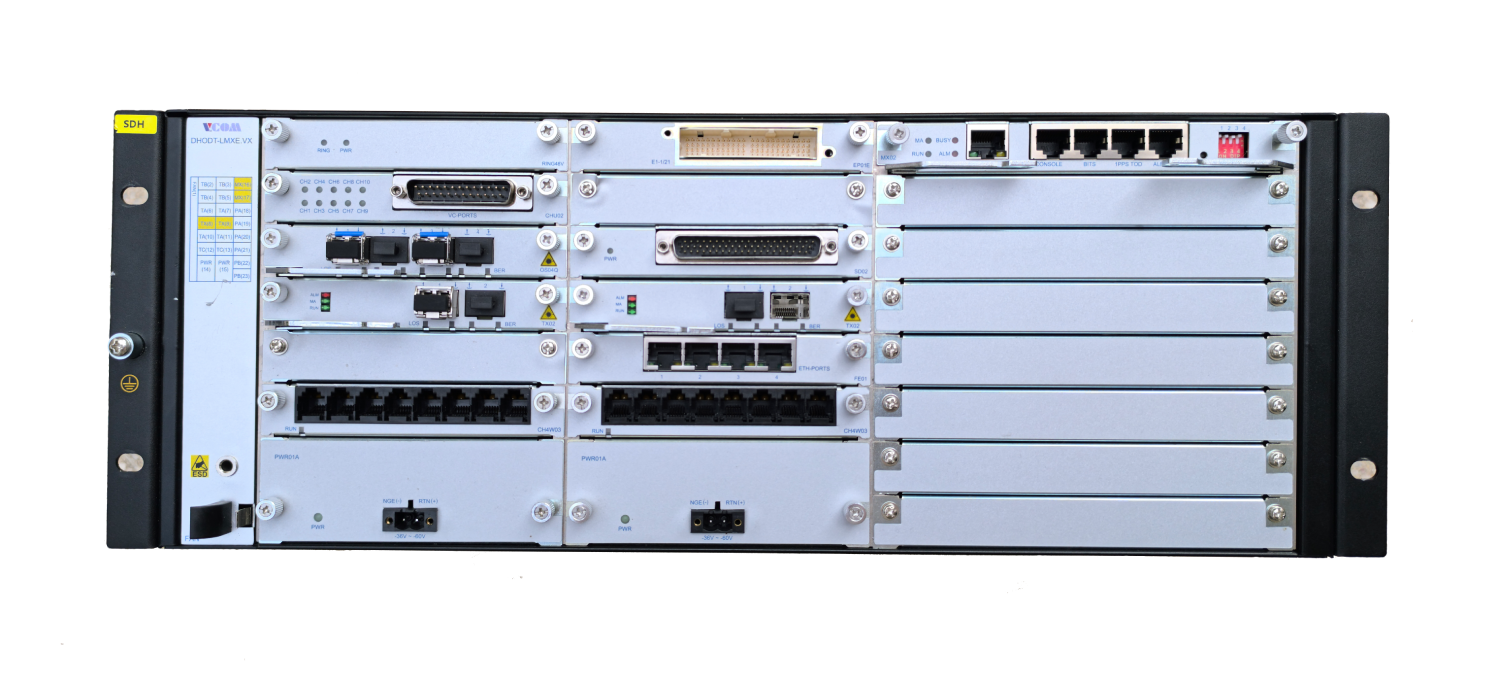
DHODT-LMXE.VX hybrid multiplexer is a carrier-class solution positioned at the IP/MPLS/PTN/SDH metro edge access layer, combining SDH and IP technologies into a single platform. It is designed to ensure a smooth transition from existing SDH networks to IP/MPLS/PTN networks.
The product connects to IP/MPLS/PTN networks through GE/10GE NNI optical interfaces, providing high Ethernet switching capacity, service-based end-to-end OAM, and advanced management functions. When connected to SDH networks, uplink interfaces support STM-4, STM-16, and STM-64, while UNI services include E1, C37.94, RS232, pass-through, and switched Ethernet. These allow seamless integration with SDH terminals, PDH terminals, and media converters. The device supports multiple network topologies such as chain, star, ring, tangent rings, and intersecting rings.
DHODT-LMXE.VX hybrid multiplexer is a carrier-class solution positioned at the IP/MPLS/PTN/SDH metro edge access layer, combining SDH and IP technologies into a single platform. It is designed to ensure a smooth transition from existing SDH networks to IP/MPLS/PTN networks.
The product connects to IP/MPLS/PTN networks through GE/10GE NNI optical interfaces, providing high Ethernet switching capacity, service-based end-to-end OAM, and advanced management functions. When connected to SDH networks, uplink interfaces support STM-4, STM-16, and STM-64, while UNI services include E1, C37.94, RS232, pass-through, and switched Ethernet. These allow seamless integration with SDH terminals, PDH terminals, and media converters. The device supports multiple network topologies such as chain, star, ring, tangent rings, and intersecting rings.
From a hardware perspective, DHODT-LMXE.VX consists of aggregation side cards and tributary side cards. The device has a 4U height and includes 22 slots, comprising two power supply card slots, two TDM master-control cross-connect card slots, two packet cross-connect aggregation card slots, ten TDM service slots, and six packet service slots. The system offers high capacity with 100G packet/120G TDM unified switching, meeting large-scale dual-plane requirements.
Its compact physical design fits standard 19-inch racks at 4U height, saving installation space. To ensure reliability, the power supply cards, TDM clock cards, and main control exchange cards operate in 1+1 hot backup mode. The SDH hard-pipe mechanism provides high-quality, low-latency transmission of TDM and packet services, while the MPLS-TP soft-pipe mechanism ensures efficient transport of large-bandwidth data services.
The device integrates PCM features to provide an all-in-one solution tailored to industry customers requiring low-rate service access. It includes 10 TDM slots supporting SDH/MSTP/MSAP/PCM service cards, 6 packet slots for IP, IPRAN, and PTN service cards, along with 2 TDM plane slots and 2 switching plane slots.
Interface support is extensive, including STM-1/4/16/64, FE/GE electrical and optical ports, 10GE ports, E1, FXO/FXS, hotline, 2/4-wire & EM, RS232/RS422/RS485, G.703 64K, C37.94, and dry contact I/O. This wide range ensures interoperability with both SDH/MSTP and IP/MPLS/PTN systems.
For power supply, the unit supports both DC (-48V) and AC (~220V) inputs. The operating temperature range is -15 °C to +60 °C, with humidity tolerance of 10–90% non-condensing. Ethernet features include L2VPN (E-Line, E-LAN, E-Tree), VPWS and VPLS (based on MPLS-TP MS-PW), ETH PWE3, IGMP Snooping V2, VLAN switching, and ACL support. QoS features cover rate limiting, priority trust, flow classification, traffic redirection, priority mapping, queue scheduling, WRED-based congestion avoidance, traffic shaping, and detailed flow statistics.
OAM support is extensive for both MPLS-TP and Ethernet. MPLS-TP OAM covers LSP/PW OAM functions (CC, LB, LT, AIS, RDI, LM, DM, LCK, TST, CSF) and Section OAM support. Ethernet OAM complies with IEEE 802.3ah, IEEE 802.1ag, and ITU-T Y.1731, including active/passive modes, link discovery, loopback, fault indication, performance monitoring, and remote power failure alarms. SLA functions such as delay, jitter, and packet loss statistics are also included, along with RMON support.
Protection mechanisms cover 1+1 hot backup at the device level, MPLS-TP linear and ring protection, and SDH MSP and SNCP service protection. Clock synchronization is supported in both Ethernet and SDH networks, with compliance to G.813, Synchronous Ethernet, and IEEE 1588v2. The device also supports adaptive clock recovery as well as external 2 MHz or 2 Mbit/s synchronization sources.